How Much Does Mold Testing Cost? A Complete 2026 Price Guide
Oct 20, 2026You have found a musty smell that will not go away, spotted dark patches behind the bathroom tiles, or you are about to buy a home and want to know what is in the air before you sign. The first question almost every homeowner asks us is a simple one: how much does mold testing cost?
The honest answer is that it depends on your home, how many samples the lab has to analyze, and how much documentation you need. But there are clear, well-established price ranges, and once you understand what drives the price, you will never overpay or fall for a quote that is too cheap to be real.
This guide breaks down the average mold testing cost in 2026, the price of every test method per sample, what testing costs here in Atlanta and across Georgia, and how DIY kits honestly compare with professional testing.
The Short Answer: Average Mold Testing Costs at a Glance
For most homes, professional mold testing costs between $300 and $600. That price normally includes the on-site visit, air and surface sampling, independent laboratory analysis, and a written report explaining the results.
Here is the full picture:
| Service | Typical Cost |
|---|---|
| Professional mold testing (standard home) | $300 to $600 |
| Professional testing, large or complex home | $700 to $1,000 |
| Mold inspection only (visual and moisture assessment, no lab work) | $150 to $400 |
| Mold inspection with testing combined | $400 to $800 |
| DIY mold test kit (petri dish or swab) | $10 to $50 |
| DIY kit with lab analysis included | $150 to $250 |
| ERMI dust test | $250 to $500 |
| Post-remediation clearance testing | $200 to $500 |
| Mold remediation (removal, for comparison) | $1,150 to $3,400 on average |
Most homeowners pay somewhere in the middle of these ranges:
- Homes under 4,000 square feet usually land in the $300 to $400 range for an inspection.
- Larger homes with crawl spaces, finished basements, or multiple HVAC systems move toward $700 to $1,000.
- Each additional lab sample beyond the included count typically adds $50 to $150.
Mold Testing vs. Mold Inspection: Why the Two Prices Get Mixed Up
A lot of price confusion comes from two terms being used as if they were the same thing. They are not, and the difference affects what you pay.
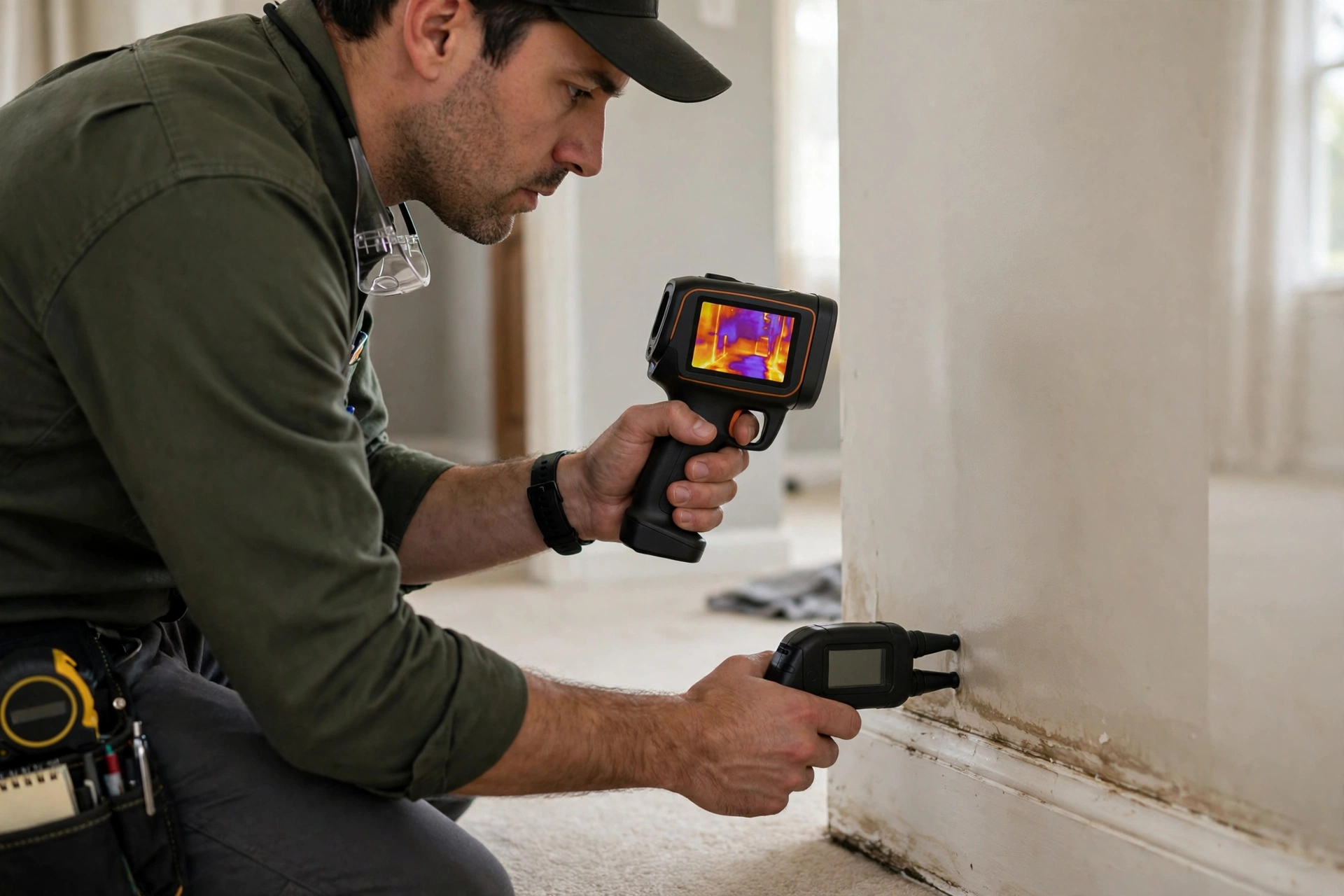
A mold inspection is the detective work. A certified mold inspector walks the property, looks for visible growth and water damage, takes moisture meter readings, and may use thermal imaging to find hidden moisture inside walls, ceilings, crawl spaces, and around the HVAC system. An inspection answers the question: where is the moisture, and where is mold likely growing?
Mold testing is the laboratory work. Samples of air or surfaces are collected and sent to an accredited lab, which identifies the mold types present and counts the spore concentration. Testing answers a different question: what kind of mold is it, and how much of it is in the air compared with outdoors?
In practice, the two are almost always bundled together in professional mold inspection and testing services, because testing without inspection gives you numbers with no context, and inspection without testing cannot confirm species. When you compare quotes, always ask whether lab fees and the written report are included, because a low headline price sometimes covers the visit only.
Mold Testing Cost Per Sample: What Each Test Method Costs
If your home needs more than the standard number of samples, the price rises per sample. Here is what each method typically costs and when it is used.
Air Sampling (Spore Trap)
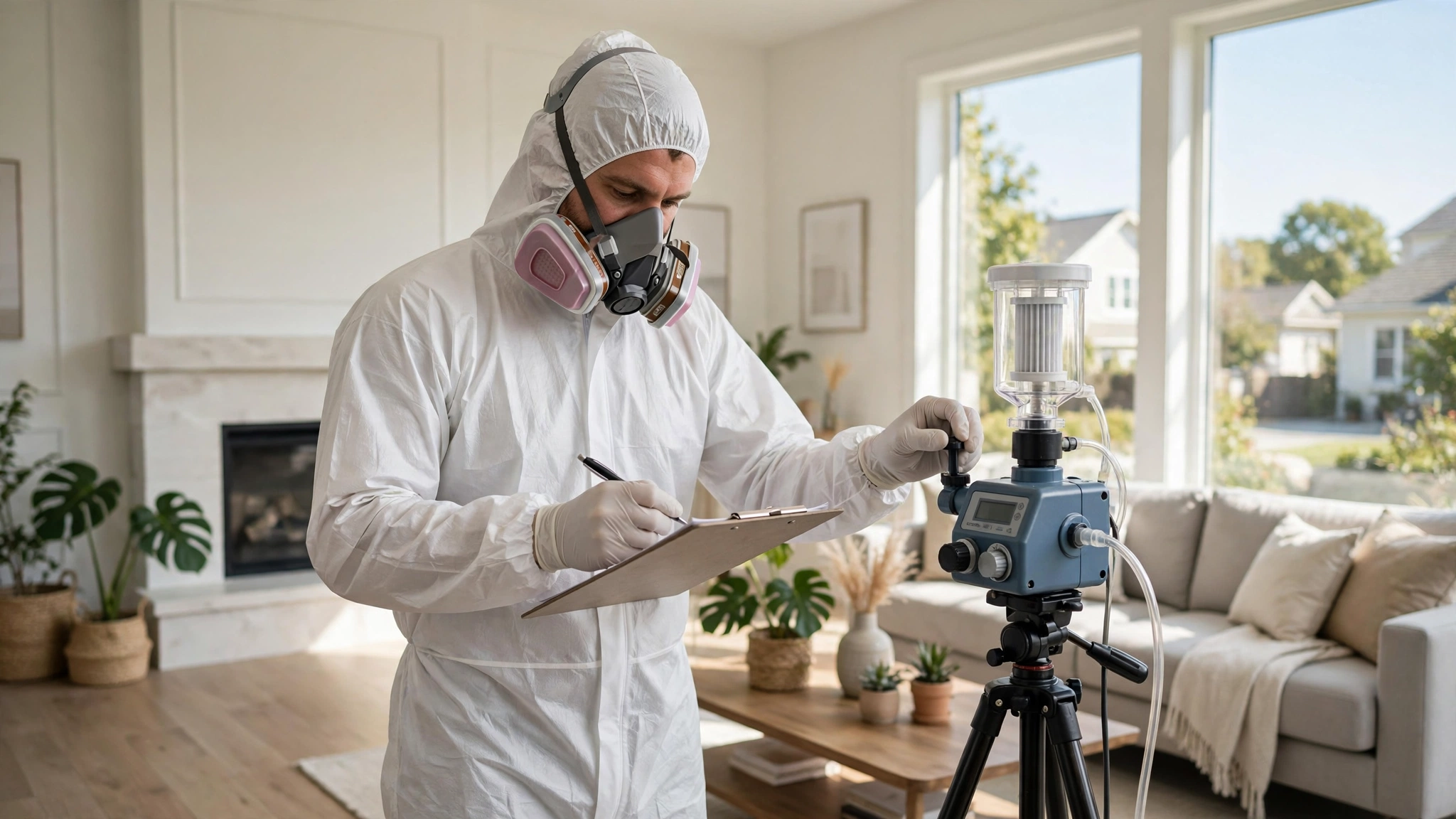
Typical cost: $90 to $150 per sample. A pump draws a measured volume of air through a cassette for about five minutes, trapping mold spores on a slide. The lab then counts the spores and identifies the types. A professional always takes an outdoor control sample as well, because indoor results only mean something when compared with the air outside your home. Air sampling is the standard method when there is a musty odor or health symptoms but no visible growth.
Surface Swab Testing
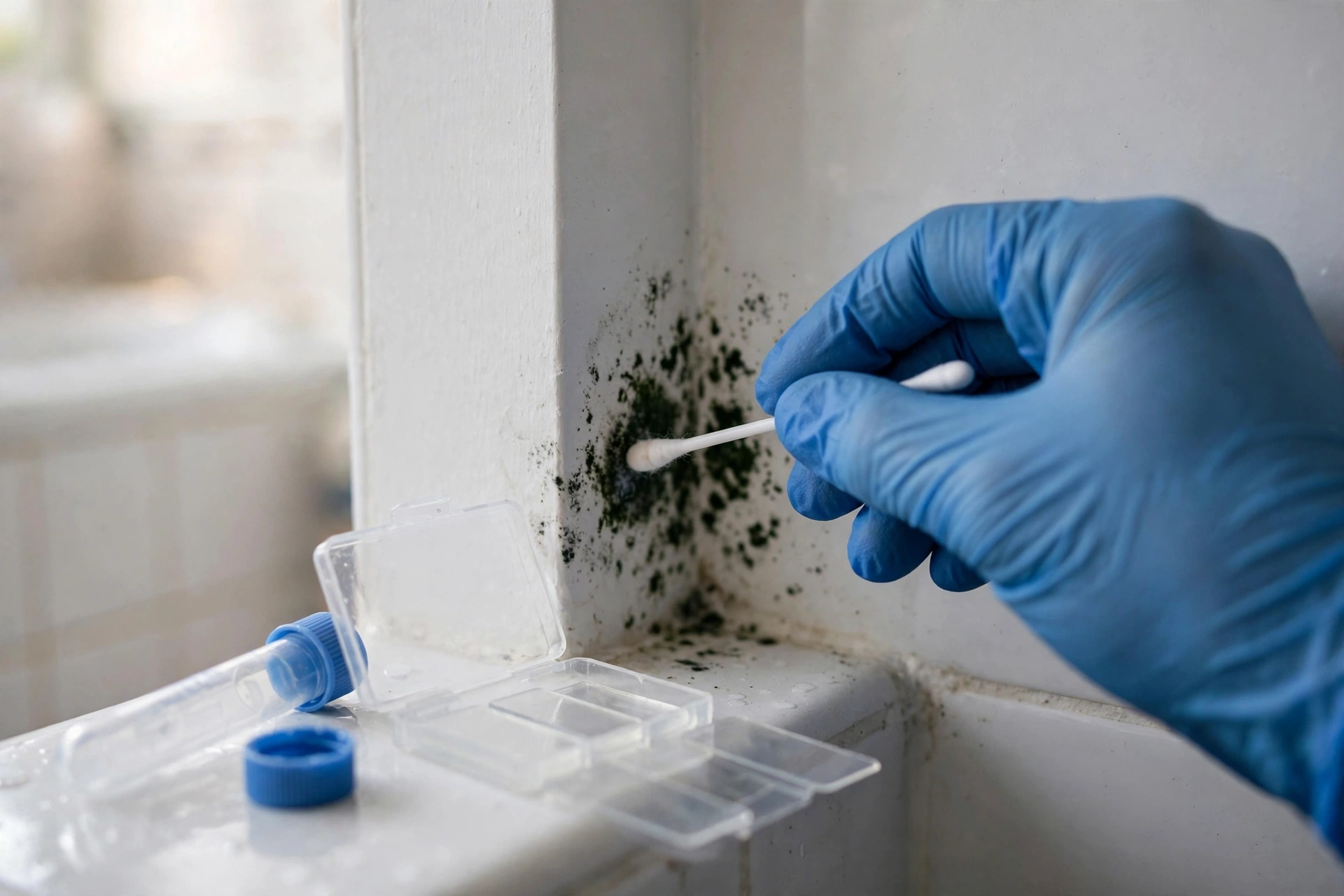
Typical cost: $90 to $270 per sample. A sterile swab collects mold from a specific visible patch, and the lab identifies the exact species growing there. Swabs are ideal for confirming whether a dark stain is Stachybotrys chartarum (the mold most people call black mold) or a harmless lookalike. A swab tells you what is on that surface; it does not measure what is in the air.
Tape Lift Sampling
Typical cost: $50 to $100 per sample. A strip of specialized tape lifts spores directly off a surface. It is one of the cheapest lab methods and is commonly used for visible growth and for post-remediation clearance checks.
Bulk and Wall Cavity Samples
Typical cost: $100 to $200 per sample. A bulk sample is a small piece of the material itself, such as drywall, insulation, or carpet, sent to the lab intact. It confirms deep contamination inside building materials. Wall cavity sampling draws air from inside a wall or ceiling through a small drilled hole, which finds hidden mold without tearing the wall open.
ERMI and HERTSMI-2 Dust Testing
Typical cost: $250 to $500. The ERMI test (Environmental Relative Moldiness Index), developed by the EPA as a research tool, analyzes settled dust for the DNA of 36 mold species and produces a score comparing your home with a national database of US homes. HERTSMI-2 is a narrower score calculated from five of those species. ERMI reflects weeks or months of accumulated dust rather than the air today, and it does not tell you where the mold is growing, so it works best alongside a proper inspection, not instead of one.
7 Factors That Change Your Final Mold Testing Price
Two homes on the same street can get very different quotes. These are the seven factors behind almost every price difference:
- Size of your home: more square footage means more rooms, more air zones, and more samples.
- Number of samples: the single biggest price driver after home size. Most packages include two or three samples; extras run $50 to $150 each.
- Where the mold is hiding: mold inside wall cavities, under flooring, in a tight crawl space, or inside the HVAC system takes longer and costs more.
- Lab fees and turnaround time: standard processing takes three to five business days. Rush results in 24 to 48 hours typically add $50 to $100 per batch.
- Your location: labor and lab costs vary by region, and humid regions with high demand sit in the middle to upper part of the national range.
- Type of property: commercial buildings and multi-unit rentals require more sampling points and more detailed reporting.
- Documentation: a detailed report that stands up in a real estate transaction, insurance claim, or landlord and tenant dispute costs more than a basic result, but it is the version that protects you.
How Much Does Mold Testing Cost in Atlanta and Georgia?
Atlanta homeowners can expect to pay $300 to $700 for a standalone mold inspection and testing visit for homes under 4,000 square feet, in line with the national range. Published Atlanta pricing shows how that range is built:
- Some local providers offer a testing package around $400 that includes the inspection plus three air samples (one outdoor control and two indoor), with additional samples around $75 each.
- Others charge a visit fee of about $270 plus roughly $90 per air sample, so two indoor samples with the outdoor control come to about $540.
- Simple packaged options start near $299 to $329.
Georgia's climate is the reason testing is in such demand here. Hot, humid summers, heavy rain, and crawl spaces built over red clay soil keep moisture levels high, and indoor humidity above 60 percent creates ideal conditions for Cladosporium, Aspergillus, and Penicillium, the species that lead Atlanta air samples, as well as Alternaria in attics after roof leaks and Stachybotrys where wood has stayed saturated for a long time. If you are buying an older home in neighborhoods like Decatur, Grant Park, or Virginia-Highland, a separate mold inspection is worth budgeting for, because a standard home inspection does not test for mold and crawl space growth is routinely missed on a visual walk-through.
DIY Mold Test Kits vs. Professional Mold Testing: Cost Compared
| DIY Mold Test Kit | Professional Mold Testing | |
|---|---|---|
| Typical cost | $10 to $50 for the kit, $150 to $250 total with lab fees for several rooms | $300 to $600 for a standard home |
| What it detects | Mold growing on a plate or surface | Airborne spore counts and species, compared with outdoor air |
| Finds the moisture source | No | Yes, inspection is part of the service |
| Identifies hidden mold | No | Yes, with moisture mapping and cavity sampling |
| Written report | Basic lab sheet or none | Full report with findings and recommendations |
| Accepted for insurance, real estate, or legal use | Generally no | Yes |
DIY kits are not useless. A $10 to $50 petri dish or swab kit can work as a rough first screen, and mail-in kits with real lab analysis give you limited but genuine data. Our own mail-order mold and air quality test kit at IAQ Answers, for example, is priced at $413 for the Standard kit and $650 for the Advanced kit, including lab analysis, reports, and shipping.
But understand the core limitation: mold spores exist in every home, so a DIY kit will almost always grow something, and the kit cannot tell you whether the level is normal, where it is coming from, or what to do next. If you want to understand what those kit results really mean, our guide on how accurate are air mold tests explains it in detail. A kit answers "is there mold?" Professional testing answers "where is it, how much is there, what species is it, and what should happen next?"
Black Mold Testing Cost: Does the Type of Mold Change the Price?
Homeowners often expect black mold testing to carry a premium price. In reality, testing for Stachybotrys chartarum costs the same as testing for any other mold. The lab does not charge by species; the same air sample or surface swab is analyzed for the full panel of common molds, which includes Aspergillus, Penicillium, Cladosporium, Alternaria, and Stachybotrys.
Where black mold does change the bill is in scope, not in the test itself. Because Stachybotrys grows on wet cellulose materials like drywall and wood, confirming it often means extra samples from wall cavities or bulk material, and if it is confirmed, the mold remediation that follows is more involved. Budget for the testing as normal, and treat any quote that charges a special "black mold fee" for the test alone with suspicion.
What Does Professional Mold Testing Include?
A proper professional service, the kind worth $300 to $600, should include all of the following:
- A visual inspection of moisture-prone areas: bathrooms, kitchen, attic, basement, crawl space, and around windows and plumbing.
- Moisture readings with a meter, and thermal imaging where hidden moisture is suspected.
- Air and surface sampling, including an outdoor control sample for comparison.
- Accredited laboratory analysis identifying mold types and spore concentrations.
- A written report that explains the findings in plain language, not just raw lab numbers.
- A consultation and clear next steps, so you know whether remediation is needed and what it should cover.
One important protection: the company that tests your home should ideally not be the company selling you the remediation. Independent testing removes the conflict of interest, because the person interpreting your results has nothing to gain from inflating the problem.

Does Homeowners Insurance Cover Mold Testing?
Usually, homeowners insurance does not pay for mold testing on its own. Policies generally respond to sudden, covered water damage events, such as a burst pipe, and in those cases remediation may be covered (often subject to a mold cap of $1,000 to $10,000, depending on the policy) while testing is treated as part of proving the claim. Mold from gradual leaks, poor ventilation, or neglected maintenance is almost never covered.
That said, a professional test report strengthens any claim you do file, because it documents the cause, the species, and the extent of contamination with lab evidence. If you plan to claim, get the testing done and keep the report, invoices, and photographs together.
How Long Does Mold Testing Take?
- The on-site visit takes one to two hours for a typical home, and two to five hours for large homes.
- Standard lab results return in three to five business days.
- Rush processing returns results in 24 to 48 hours.
From booking to answers, most homeowners are looking at under a week.
Is Mold Testing Worth the Cost?
Compared with the cost of getting it wrong, yes, in most real situations. Professional remediation averages $1,150 to $3,400 and can exceed $10,000 to $20,000 in severe cases. A $300 to $600 test that confirms you do not need remediation, or that limits remediation to the one area that actually needs it, pays for itself immediately.
Testing is worth every dollar when:
- You smell musty odors but can see no mold, which points to hidden growth.
- Family members have coughing, wheezing, sinus, or skin symptoms that improve when they leave the house.
- You are buying or selling a home and need lab documentation for disclosure and negotiation.
- You have had water damage, a leak, or flooding, especially if drying was delayed.
- You need post-remediation clearance testing before paying a remediation contractor's final bill.
- An insurer, landlord, tenant, or attorney requires certified documentation.
When you can honestly skip it: the EPA's guidance is refreshingly direct. If mold is visibly growing and you have already found the moisture source, sampling is usually unnecessary, because the cleanup decision is the same regardless of species. In that case, spend the money on fixing the moisture problem instead, because mold that is cleaned without fixing the water source simply comes back.
How to Avoid Overpaying for Mold Testing
- Ask what the quote includes. Visit, samples, lab fees, and written report should all be named, and per-sample charges agreed in advance.
- Ask which lab analyzes the samples and whether it is independent and accredited.
- Beware the free inspection that sells remediation. A free look from a company that profits from removal work is a sales call, not an assessment.
- Match the testing to a question. Good inspectors sample where the inspection finds a reason to sample. Testing every room "just in case" inflates the bill.
- Get the report in writing, with a consultation to explain it. Raw lab numbers without interpretation are only half a service.
Frequently Asked Questions About Mold Testing Costs
How much does mold testing cost for a typical home?
Professional mold testing for a typical home runs $300 to $600, including sampling, independent lab analysis, and a written report. Larger homes or homes needing more sample points can reach $700 to $1,000.
How much does mold testing cost per sample?
Expect roughly $50 to $100 for a tape lift, $90 to $150 for an air (spore trap) sample, $90 to $270 for a surface swab, and $100 to $200 for bulk or wall cavity samples. Most inspections include two or three samples in the base price.
How much does a mold inspection cost without testing?
A visual and moisture inspection without lab work typically costs $150 to $400. It identifies moisture sources and suspect areas, but it cannot confirm mold species or airborne spore levels.
Are DIY mold test kits worth it?
They are a reasonable cheap first screen at $10 to $50, or $150 to $250 with lab analysis, but they cannot find hidden mold, locate the moisture source, or produce a report accepted for insurance, real estate, or legal purposes.
Does insurance pay for mold testing?
Rarely on its own. Insurance may cover remediation after a sudden covered water event, and a professional test report strengthens that claim, but routine testing is normally the homeowner's cost.
How long do mold test results take?
Standard lab turnaround is three to five business days. Rush processing returns results in 24 to 48 hours and typically adds $50 to $100.
Should I test if I can already see mold?
Usually not, per EPA guidance. If growth is visible and the moisture source is known, go straight to cleanup and moisture repair. Testing adds value when mold is suspected but hidden, when documentation is required, or after remediation to verify the work.
Get an Exact Price for Your Home
Every home's price comes down to its size, the number of samples that make sense, and how much documentation you need, and none of that can be guessed responsibly from a web page. What we can do is talk it through in a few minutes and give you an exact, honest figure with no obligation.
Schedule Your Indoor Air Quality Check Today
Worried about the air inside your home? Our professional indoor air quality inspections help identify hidden pollutants, allergens, and airflow issues so you can breathe cleaner, healthier air with confidence.